Updated: May 2026 | The global semiconductor foundry race has never been more intense — or more consequential for investors. Samsung Foundry, once written off as TSMC's distant second, is mounting a comeback that has Wall Street and Big Tech paying close attention. Here's everything you need to know.
📌 Quick Summary
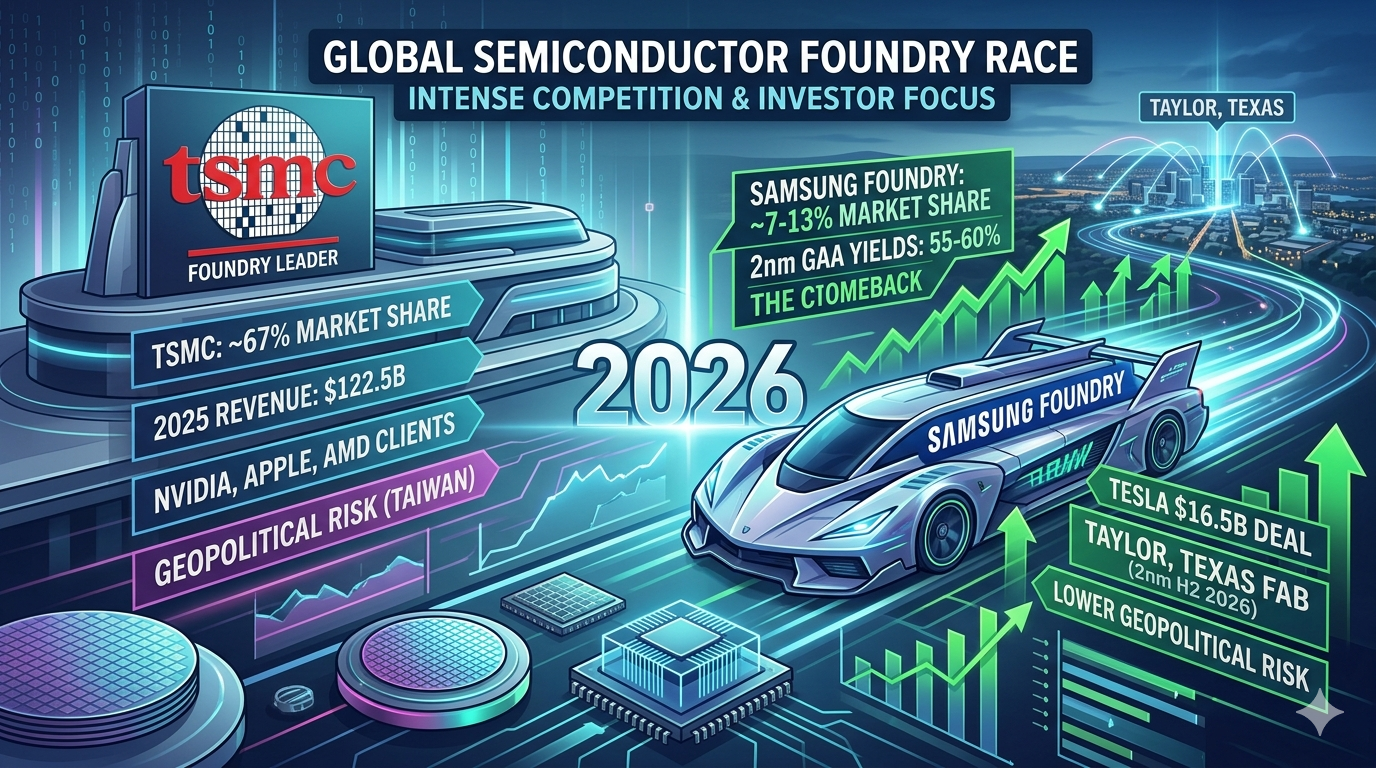
- TSMC holds ~67% foundry market share; Samsung is at ~7–13% depending on the metric
- Samsung's 2nm GAA yields have climbed to 55–60% (late 2025), up from ~30% in early 2025
- Tesla signed a $16.5B foundry deal with Samsung — the largest single-client contract in foundry history
- Samsung's Taylor, Texas fab is targeting full-scale 2nm production in H2 2026
- Geopolitical risk around Taiwan is pushing hyperscalers to diversify — Samsung is the primary beneficiary
🔍 Q1. What is the current foundry market share of Samsung vs TSMC?
As of Q1 2025, TSMC commands approximately 67.6% of the global foundry market with $25.5 billion in quarterly revenue, according to TrendForce. Samsung Foundry sits in second place with roughly 7.7% market share — a notable decline from 11% in Q1 2024.
In full-year 2025, TSMC captured nearly 70% of the global foundry business, generating $122.5 billion in revenue — up 36% year-over-year, driven almost entirely by AI chip demand from Nvidia, Apple, and AMD. (Source: IBTimes Australia, May 2026)
The gap is stark. But the question for investors is not where Samsung stands today — it's where it's headed.
🔍 Q2. Why has Samsung Foundry been losing ground to TSMC?
Samsung's foundry struggles boil down to one persistent problem: yield rates. Yield refers to the percentage of usable chips produced per wafer — low yields mean higher costs, delayed deliveries, and unhappy customers.
At its 3nm node (launched in 2022), Samsung pioneered Gate-All-Around (GAA) transistor technology — becoming the first company in the world to ship 3nm chips. But yields were deeply problematic, reportedly in the 10–30% range at peak difficulty, causing major customers to hesitate. TSMC, by contrast, stayed with its proven FinFET architecture longer and delivered more consistent yields.
The result? Customers like Qualcomm, AMD, and Google largely continued routing their most critical orders to TSMC. Samsung's foundry division has been running at a loss for several consecutive years.
🔍 Q3. What is Samsung doing to fight back in 2026?
Samsung's turnaround strategy rests on three pillars:
① 2nm GAA — Yield Recovery
Samsung's 2nm process (SF2) is showing real progress. Yield rates climbed from approximately 30% in early 2025 to 50% by Q3 2025, and reached an estimated 55–60% by end of 2025, according to Chosun Daily and TrendForce. The target is 70%+.
Compared to its 3nm stumble, this is a significant improvement curve. The 2nm node also delivers tangible performance gains: 5% faster, 8% more power-efficient, and 5% smaller than the previous 3nm generation. (Source: Samsung Q3 2025 earnings, via TweakTown)
② Landmark Customer Wins
In mid-2025, Samsung secured a landmark $16.5 billion (≈24.28 trillion KRW) contract with Tesla to manufacture the AI6 autonomous driving chip — the largest single-client foundry deal in history. (Source: Chosun Daily / TrendForce, Nov 2025)
Beyond Tesla, Samsung is in advanced talks with AMD and Qualcomm for 2nm capacity at its Texas facility. Google's TPU team has also visited Samsung's Taylor fab to explore potential production deals. (Source: TrendForce / EBN, Dec 2025)
Samsung's 2nm order pipeline is expected to grow 30%+ year-over-year in 2026, with some estimates as high as 130% growth. (Source: TrendForce / WCCFTech, Jan–Feb 2026)
③ Taylor, Texas Fab — The "Made in USA" Card
Samsung's $44 billion Taylor, Texas fab is on track to commence risk production in H2 2026, with full mass production targeted by end of 2026. The facility targets 50,000 wafer starts per month (WSPM) — larger than a typical TSMC fab module. (Source: Tom's Hardware, Jan 2026)
This is Samsung's most powerful selling point right now. TSMC's Arizona fabs are producing 4nm chips (online late 2024) and won't reach 3nm until 2027 — already two nodes behind the cutting edge due to Taiwan's export restriction policy (N-2 rule). Samsung's Texas fab will produce 2nm chips — the most advanced process available on U.S. soil. (Source: TrendForce, Dec 2025)
🔍 Q4. What is TSMC's position — is it vulnerable at all?
Let's be honest: TSMC is not going anywhere. Its advantages are structural and deeply entrenched:
- Customer trust: TSMC doesn't design its own chips and never competes with clients — Samsung does both, which creates an inherent conflict of interest
- Yield superiority: TSMC's 2nm yields are estimated at 70%+, well ahead of Samsung's 55–60%
- AI dominance: Nvidia, Apple, AMD, Qualcomm — TSMC manufactures the most critical AI chips in the world
- 2025 revenue: $122.5B, up 36% YoY, with $45B+ CapEx planned for 2026
But TSMC does have one growing vulnerability: geopolitical concentration. Over 90% of the world's most advanced chips are manufactured in Taiwan. Escalating U.S.-China tensions have made this a board-level risk for every major tech company. (Source: Z2Data / IBTimes, 2026)
🔍 Q5. Why does geopolitics matter so much — and how does it help Samsung?
The hyperscalers — Microsoft, Google, Amazon, Meta — cannot afford to have their AI infrastructure dependent on a single geography that could be disrupted overnight. Taiwan remains the world's most geopolitically sensitive semiconductor region.
Intel's foundry business is in disarray (not even in the top 10 globally). That leaves Samsung as the only credible alternative for leading-edge chip manufacturing outside of Taiwan.
As one analyst summarized: "The hyperscalers have no choice but to diversify. Intel Foundry is broken. TSMC is expensive, capacity-constrained, and geopolitically risky. And AI is too important to bet everything on a single supplier concentrated in Taiwan." (Source: Future Digest News / Substack, Mar 2026)
Samsung's Taylor fab — on U.S. soil, eligible for CHIPS Act subsidies, already contracted to Tesla — directly addresses this diversification need.
🔍 Q6. What about pricing — does Samsung have a cost advantage?
Yes, and it's significant. Industry insiders suggest Samsung's 2nm wafers could be priced approximately 33% lower than TSMC's equivalent offering — a crucial margin buffer for chip designers facing rising manufacturing costs. (Source: The Pilot News / Financial Content, Feb 2026)
For fabless companies like Qualcomm, this price gap — combined with dual-sourcing risk management — makes Samsung increasingly attractive even if TSMC remains the preferred tier-1 option.
🔍 Q7. What is the investment outlook — Samsung or TSMC for 2026?
This is ultimately the question most readers care about. Here's the honest breakdown:
| Factor | TSMC | Samsung |
|---|---|---|
| Market share | ~67% (dominant) | ~7–13% (recovering) |
| 2nm yield | 70%+ (leading) | 55–60% (improving) |
| Geopolitical risk | High (Taiwan) | Lower (Korea + Texas) |
| Valuation | Premium | Discount (turnaround) |
| Profitability timeline | Now (high margin) | Foundry profit ~2027 |
| Upside potential | Steady, high quality | High risk, high reward |
Most Wall Street analysts favor TSMC as the core semiconductor holding — stable, dominant, and directly tied to AI infrastructure growth. Samsung is the higher-risk satellite bet for investors who believe the foundry turnaround story plays out by 2027. Many portfolio advisors recommend holding both. (Source: IBTimes Australia, May 2026)
🔍 Q8. What is Samsung's GAA advantage — and why does it matter long-term?
Here's a nuance that most coverage misses: Samsung actually has a structural long-term advantage in transistor architecture.
Gate-All-Around (GAA) is the next-generation transistor design that replaces FinFET at 2nm and below. Samsung adopted GAA at 3nm (2022) — two full nodes ahead of TSMC, which is only now transitioning to GAA at its 2nm node. This means Samsung has been accumulating real-world GAA manufacturing experience since 2022, while TSMC is just beginning its GAA learning curve. (Source: TrendForce / Chosun Daily, Nov 2025)
If Samsung can stabilize its yields and scale its GAA process, it could emerge as the more experienced player at 1.4nm and beyond. Samsung has already announced its 1.4nm roadmap targeting mass production in 2029.
📊 Key Data Points at a Glance
- Global foundry market size 2026: projected to exceed $360 billion
- TSMC 2025 revenue: $122.5B (+36% YoY)
- Samsung foundry Q1 2026 utilization: 80% (one-year high)
- Samsung 2nm yields: 55–60% (target: 70%+)
- Tesla deal: $16.5B for AI6 chips at Taylor fab
- Samsung 2nm wafer pricing: estimated ~33% cheaper than TSMC
- Samsung foundry profitability expected: ~2027
- Samsung 1.4nm target: 2029
✅ Bottom Line
Samsung will not overtake TSMC in 2026. But the more important question is: is Samsung's foundry turnaround real?
The evidence increasingly says yes. Yields are improving. Customers are signing. The Texas fab is coming online. And geopolitics is doing Samsung a favour that no marketing budget could buy.
For investors, 2026 is the year to watch Samsung Foundry closely — not because it will dethrone TSMC, but because it may finally stop losing the race.
⚠️ Disclaimer
This post is for informational purposes only and does not constitute investment advice. All investment decisions and their outcomes are the sole responsibility of the individual investor. Please consult a qualified financial advisor before making any investment decisions.
📚 Sources
- TrendForce — Foundry Market Share Q1 2025 (June 2025)
- TrendForce — Samsung 2nm Order Growth Report (Jan 2026)
- TrendForce — Samsung 55–60% 2nm Yields (Nov 2025) <l
'Economy' 카테고리의 다른 글
| The End of TSMC's Monopoly? Why Apple, Tesla & NVIDIA Are Quietly Turning to Samsung and SK Hynix (1) | 2026.05.08 |
|---|---|
| SK Hynix HBM4 Strategy: Why It Remains the AI Memory King in 2026 (0) | 2026.05.04 |

